Passing a Resolution
Through a State Medical Association
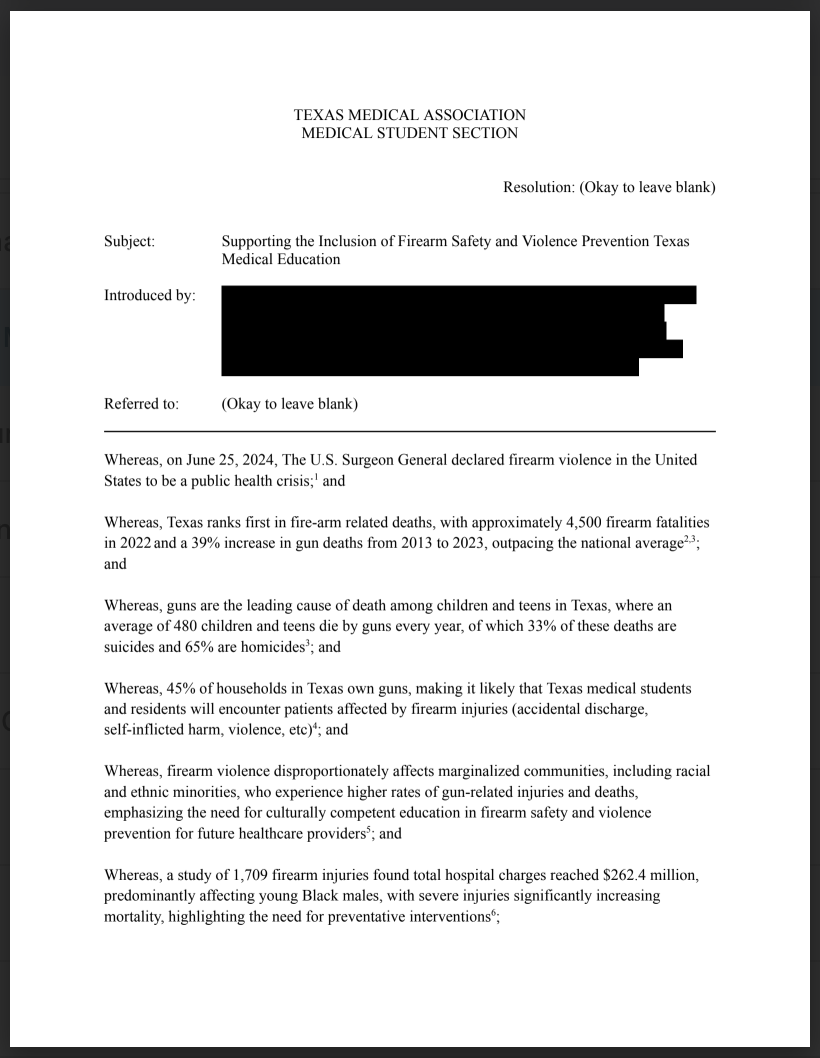
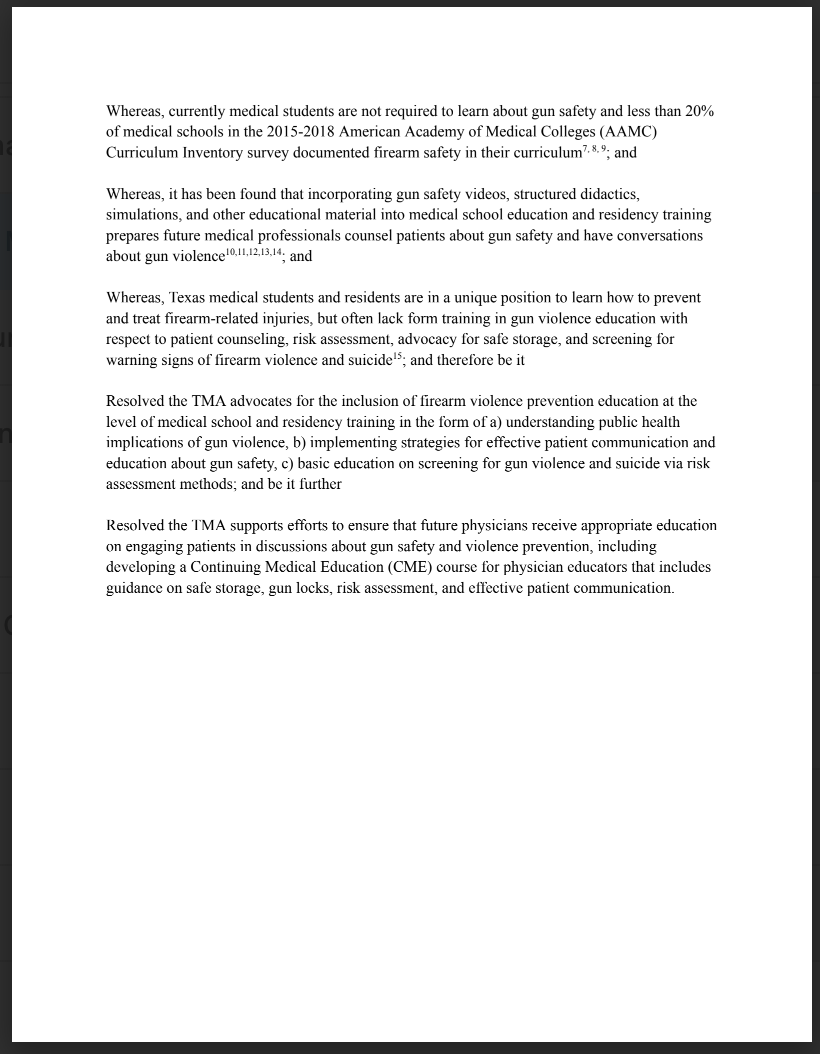
The SAFE Chapter at Texas A&M Naresh K Vashisht College of Medicine led a resolution to support firearm safety education in medical school and residency.
The Resolution was ultimately adopted by the Texas Medical Association at the TexMed 2026 Conference.
The full process took about six months and included multiple drafts, two rounds of formal feedback, student voting, and final approval with amendments at the conference.
Listen to how the SAFE Chapter students did it. See the steps below.
Lead a Resolution to Support Firearm Safety Education in
Medical School and Residency
While details may vary between states, this guide can be adapted to other state medical associations.
Click on the plus (+) sign to see description and helpful advice for the next steps.
-
Review your State Medical Association’s policies to identify meaningful gaps.
If there is already an existing policy that covers your proposal, consider connecting with the society to take action on that policy.
-
Proposal Feasibility and Impact
Do they think your proposal is feasible? Do they have advice on how to approach this subject within your state society?
Do they think your proposal will have a positive impact in your state?
Submission Process
What is the submission process, including deadlines, for your state?
For example:
States vary by how formal vs informal the process is.
You may be required to submit your idea to the Student Section for a formal approval process with rounds of feedback and scoring prior to official submission to the State Medical Association.
You may not have to undergo a formal approval process and may instead seek out informal feedback from involved parties prior to official submission.
-
What supporting evidence is there for your policy proposal?
How is your policy relevant to your state?
What existing state and national policies support your proposal?
-
Includes Two Parts: Whereas and Resolved Clauses
Whereas clauses are background facts that provide evidence as to why this resolution is important. The evidence must be cited.
Resolved clauses are the actual policies that are proposed with actions that the medical association would have to implement if the resolution is adopted.
Relevant state and national (AMA) policies that have been passed in this area should be listed below the body of the resolution.
Recommendations:
Be broad in the actual implementation of the resolved clauses. If your resolved clause involves medical education, this will allow medical schools and residency programs to adapt the content how they want to.
Do not include CME in your resolution if (like in Texas) CME clauses have been picked up by legislators and made into required learning modules for physicians. Physicians don’t like the possibility of being told what to do!
-
Follow your state’s submission guidelines and deadlines.
If relevant, first submit to your Student Section.
Formally submit your proposal for consideration by the State Medical Association.
-
Your proposal may be assigned to a relevant reference committee for review.
At this stage, county medical societies, specialty groups, subcommittees, and caucuses can submit written and oral testimony supporting or opposing your resolution. In some states, it may be open to commentary for all society members in general.
What happened in Texas: There was significant criticism regarding the level of specificity and the CME component. Some groups were concerned about implementation across different training programs and adding new requirements for physicians.
-
The board and/or reference committee reviews all testimony, amends the resolution based on testimony, and publishes a report with recommended changes. You may have an opportunity to state your rationale and thoughts on proposed amendments at this stage.
Key outcome for Texas: The CME component was removed and language was made broader and less prescriptive.
-
These last few steps can vary greatly by state society.
The board or committee will release a final decision to adopt vs referred for research vs discuss further.
In some states, this may occur at a society conference and may be the stage where you can provide testimony and choose to support or oppose the committee’s amendments. In others, this step may occur in a different format.
-
The Final Reference Committee report is released with all of the policy recommendations that were made.
Resolutions are only debated on the main floor of the House of Delegates if decided by the committee or if someone chooses to pull them for discussion. Most of the time, the House of Delegates agrees with the committee’s recommendation on a resolution and the Reference Committee’s determination is adopted.
In other states, this may be an informal process where members can share feedback on the board or committee decision.
-
Remember to continue the work and stay connected with your state medical society to encourage the implementation and use of new policy.
Share the new policy position with your medical school administration and encourage them to begin considering how to incorporate this curriculum.
After the Delegation Decision:
Remember to continue the work and stay connected with your state medical society to encourage the implementation and use of new policy.
Share the new policy position with your medical school administration and encourage them to begin considering how to incorporate this curriculum.
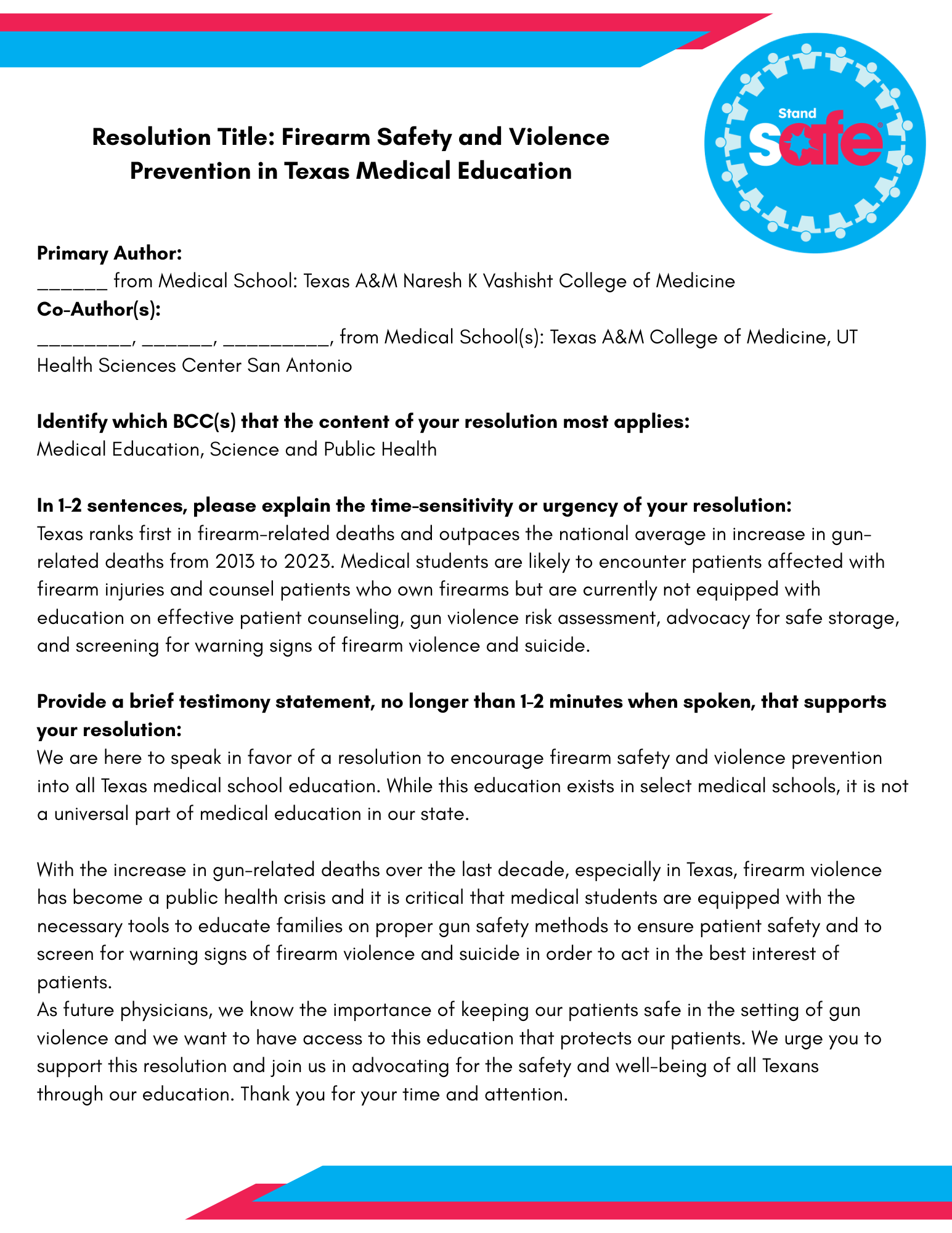
Texas Resolution Example
Special thank you to the student and faculty leaders of the SAFE Chapter at Texas A&M Naresh K Vashisht College of Medicine in 2026 for putting together this guide, and putting in the work.